This statutory annual corporate governance statement
for A.P. Møller - Mærsk A/S is part of the Directors' report
in the 2010.
This statutory annual corporate governance statement
for A.P. Møller - Mærsk A/S is part of the Directors' report
in the 2009 Annual Report and covers the financial
period 1 January to 31 December 2009.
The statement includes a description of the Company's
management structure, a review of how the Company
considers the "Recommendations for corporate governance"
issued by NASDAQ OMX Copenhagen as well as a
description of the main elements of the Group's internal
control and risk management systems in connection
with the Group's financial reporting.
MANAGEMENT STRUCTURE
As a Danish listed Company, A.P. Møller - Mærsk A/S
has a management structure consisting of the Board of
Directors and the Management Board.
The Board of Directors
Pursuant to the articles of association, the Board of
Directors shall consist of 4-13 members elected by the
Annual General Meeting. The Board members elected at
the Annual General Meeting are elected for a two-year
term. This means that every year some of the members
are up for election and ensures continuity in the work
of the Board of Directors. Board members are eligible for
re-election. Today, the full Board consists of 12 members.
The Board elects its Chairman and two Vice-chairmen
among its members.
The Board of Directors lays down the general business
and management principles for the A.P. Moller - Maersk
Group and ensures the proper organisation of the Company.
The Board of Directors usually meets 7-9 times a year
and is otherwise convened when deemed necessary.
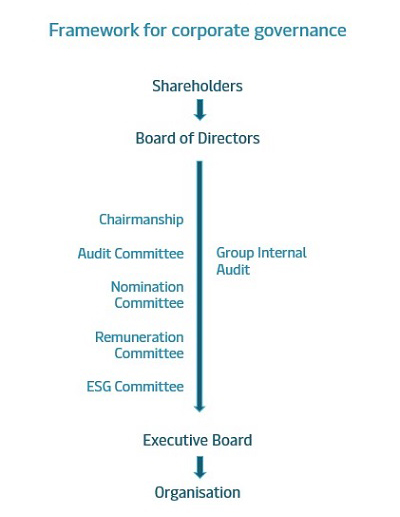
The Board of Directors is organised into the following
committees:
The Chairmanship, which consists of the Chairman of
the Board of Directors, Michael Pram Rasmussen, and
the Vice-chairmen, Poul J. Svanholm and Ane Mærsk
Mc-Kinney Uggla. The Chairmanship meets regularly
and as required.
The Audit Committee consists of 3-4 Board members
appointed
by and among the Board members of
A.P. Møller - Mærsk A/S. The committee currently
consists of three members (Jan Tøpholm, Lars Kann-
Rasmussen and Leise Mærsk Mc-Kinney Møller) and
reports to the Board of Directors. The tasks of this committee
include the review of accounting, auditing, risk
and control matters, among other things at meetings
with the external auditors and the Heads of Accounting
and Group Internal Audit. The committee determines the
frequency of its meetings and usually meets three times
a year. The tasks of the Audit Committee are described in
terms of reference and a set of procedures approved by
the Board of Directors.
The Remuneration Committee consists of the Chairman
and the two Vice-chairmen. At the Board meeting
at which the annual report is considered, the committee
makes a proposal for the remuneration of the Management
Board (Firmaet A.P. Møller). The committee approves
the allocation of the remuneration among the
partners of Firmaet A.P. Møller and also decides on the
annual adjustment of salaries in per cent for the staff
of Rederiet A.P. Møller A/S and Mærsk Olie og Gas A/S.
Furthermore, the committee determines the size of the
proposed annual
overall remuneration, including pensions,
bonuses
and the like, for key executives of the
A.P. Moller - Maersk Group worldwide. The committee
meets as and when required.
For names and photos of the Board members, please refer
to http://investor.maersk.com/directors.cfm.
The Management Board
The Management Board of A.P. Møller - Mærsk A/S consists
of Firmaet A.P. Møller, a Danish partnership. The
partners of Firmaet A.P. Møller are Mærsk Mc-Kinney
Møller, Nils S. Andersen, Claus V. Hemmingsen, Eivind
Kolding and Søren Skou. Each of the partners can commit
A. P. Møller - Mærsk A/S by signing on behalf of
Firmaet
A.P. Møller using the signature "A.P. Møller".
Executive Board
The Executive Board functions as the day-to-day management
and consists of Nils S. Andersen
(Group CEO),
Claus V. Hemmingsen, Eivind Kolding, Søren Skou, Trond
Westlie (Group CFO) and Jakob
Thomasen.
In the following, the Management Board and the Executive
Board are collectively referred to as "the Management".
Remuneration of the Management
The remuneration payable to the Management Board is
determined by considering what is reasonable in relation
to the size, activities and other circumstances of
the Company. A total of DKK 111 million was paid to the
Management Board in 2009, and is disclosed in note 4 of
the 2009 Annual Report. The Board of Directors is paid
a fixed remuneration determined for one year at a time.
Special remuneration is paid for participation in committees.
The total remuneration to the Board of Directors
is disclosed in note 4 of the 2009 Annual Report and
amounted to DKK 16 million in 2009.
In order to attract, retain and motivate the key executives
of the A.P. Moller - Maersk Group, and in order to emphasise
alignment between these employees' interests and
the interests of the shareholders, a long-term incentive
programme for the Group's key executives, comprising
about 110 people, was established in March 2008.
A significant element of this is a share option programme,
which once a year will grant the applicable
employees share options at a fair value corresponding to
1-2 months' pay for the individual employee.
The options are allocated with a "strike price" of 110% of
the average of the share prices (for A.P. Møller - Mærsk
A/S B shares "all trades") on the first five trading days
following the publication of the Company's annual report.
The options are exercisable after two years and
within five years at the latest. The first grant of share
options took place in April 2008.
A similar incentive programme was introduced for the
members of the Management Board with effect from
April 2008. At their own expense, they are obliged to
acquire
share options at market value for an amount
corresponding to about two months' remuneration.
At the Annual General Meeting on 29 April 2008,
the "General Guidelines for Incentive Pay" for the
Management of A.P. Møller - Mærsk A/S were
adopted. The guidelines are published at
www.investor.maersk.com/da/guidelines.cfm.
Internal audit
The main focus of the A.P. Moller - Maersk Group's internal
audit function (Group Internal Audit) is to review the
efficiency of the internal control and risk management
systems and to deal with the prevention and detection
of any irregularities.
The Head of Group Internal Audit reports to the
Chairman of the Board of Directors and to the Audit
Committee.
RECOMMENDATIONS FOR CORPORATE GOVERNANCE IN DENMARK
The Board of Directors of A.P. Møller - Mærsk A/S continues
to consider the "Recommendations for corporate
governance" prepared by NASDAQ OMX Copenhagen.
Most of the recommendations have been complied with,
but there are some which the Board of Directors has
chosen not to follow. With reference to the "comply or
explain" principle, NASDAQ OMX Copenhagen has stated
that companies should either comply with the recommendations
or explain why they deviate from them.
The role of the shareholders and their interaction with the management of the Company
Communication between A.P. Møller - Mærsk A/S and
the shareholders is carried out primarily at the Annual
General Meeting and through company announcements.
In addition, online presentations are made for investors,
analysts, the press and other stakeholders in connection
with the publication of annual and interim reports and
interim management statements, and individual meetings
are held with share analysts as well as current and
potential investors. Investors and share analysts are
welcome to contact the Company's Investor Relations
office.
Information about the Group's activities, capital structure,
press releases, company announcements and
annual reports is published at maersk.com. The annual
report, press releases and company announcements are
published in both Danish and English.
The Annual General Meeting constitutes, within the
boundaries laid down in the articles of association, the
supreme authority in the affairs of the Company. The
Annual General Meeting must be held in Copenhagen,
Svendborg or Århus, Denmark, before the end of April.
In accordance with the articles of association, Annual
General Meetings are normally convened with three
weeks' notice, but must be convened at no fewer than
eight days' and no more than four weeks' notice. Notices
of Annual General Meetings are announced in the Danish
daily press and in the Danish Commerce and Companies
Agency's information system. Registered shareholders
receive an invitation with an agenda and appendices, including
the annual report, if requested. They also receive
a proxy form on which they can record their proxy voting
instructions for each item on the agenda. The Board
of Directors or a named third party can be appointed
proxy. It is also possible to appoint a proxy via maersk.
com. This ensures that shareholders can exercise their
voting rights even though they are not able to attend the
Annual General Meeting.
The annual report, agenda and other published material
as well as other useful information concerning the Annual
General Meeting are all available at maersk.com.
Procedures for the Company's Annual General Meeting
are laid down in articles 8-14 of the articles of association.
The articles of association are available at
http://investor.maersk.com/guidelines.cfm.
The Board of Directors believes that the Company's capital
structure, together with the majority shareholding
held by the A.P. Moller Foundations, benefits the development
of the Company, and that a continuation would be
advantageous to both class A and class B sharesholders.
The role of stakeholders and their
importance to the Company
The Board of Directors has laid down guidelines for the
Company's relationship with its stakeholders. In "The
Maersk Principles of Conduct", which is available at
maersk.com, the Board of Directors has laid down the
fundamental business principles that describe, on the
basis of the Company's fundamental values, the Company's
relationship to the local communities in which
the Group operates, as well as policies on environmental
and labour-related matters, etc.
Openness and transparency
The Management has prepared an information and
communication policy, which has been approved by the
Board of Directors.
Significant information of importance to the assessment
of A.P. Møller - Mærsk A/S and its activities, business
objectives, strategies and results by shareholders and
the financial markets is published as soon as possible
via company announcements.
In order to ensure ongoing dialogue between the Company
and its existing and potential shareholders as well
as share analysts, etc., an Investor Relations office to
which questions concerning the Company can be addressed
has been established.
The Company's annual report is prepared in accordance
with "International Financial Reporting Standards"
(IFRS) as adopted by the EU as well as Danish disclosure
requirements for the annual reports of listed companies.
The annual report, which also includes a range of
non-financial disclosures, is published at maersk.com.
In connection with the preparation of the Company's annual
report, the Board of Directors decides on additional
relevant non-financial disclosures.
Annual and interim reports as well as interim management
statements and announcements on significant
(share price relevant) circumstances concerning the
Company, are presented. They are all published at
maersk.com. Announcements are published between
annual and interim reports and interim management
statements when changes or circumstances that may
influence the share price occur.
The duties and responsibilities
of the Board of Directors
As prescribed by Danish law, the Board of Directors is
responsible for the overall governance of the Company
and lays down guidelines for, and supervises the work
of, the Management. The development and definition of
the Group's strategies constitute an important management
task. The Board of Directors regularly discusses
and determines its duties in this relation, at least once a
year.
The Board of Directors has established a set of procedures.
At individual Board meetings, the Board of Directors
decides which duties are to be performed on a daily
basis and in the long term. It is the opinion of the Board
of Directors that this method of operation is the most
suitable for the Company more appropriate, for example,
than formal, detailed job and duty descriptions for
the Chairman and the Vice-chairmen which could prove
restrictive.
The Board of Directors is organised with a Chairman and
two Vice-chairmen. When allocating the duties of the
Board of Directors, and during the general discussion
at Board meetings, the Chairman strives to ensure that
the special knowledge and competence of the individual
Board members are put to the best possible use for the
benefit of the Company.
The Board of Directors' set of procedures outlines the reporting
made by the Management to the Board of Directors.
This is to ensure that the Board of Directors receives
on an ongoing basis the information it requires regarding
the Company's activities.
The set of procedures for the Board of Directors' is reviewed
once a year to ensure alignment with the requirements
of the Company.
The composition of the Board of Directors
The Board of Directors has authorised the Chairman to
ensure a thorough and transparent process for the selection
and nomination of candidates to the Board. This is
intended to ensure a composition that provides the skills
and expertise necessary for the Board to perform its duties
in the best possible way.
Candidates are presented to the entire Board of Directors
which makes an assessment of the professional and personal
qualifications of potential candidates. A number of
recruitment criteria can be established, but it is the opinion
of the Board of Directors that it is neither appropriate
nor relevant to prepare an exhaustive list of specific recruitment
criteria. This means that the recommendation
to provide information about the recruitment criteria
established by the Board of Directors is not followed.
The individual Board members have been nominated
and elected on the basis of an overall assessment of the
qualifications of the Board of Directors and the individual
members, including any relevant and necessary
knowledge and experience in relation to the needs of
the Company. The other management positions and
significant organisational duties of the individual Board
members are disclosed in the annual report. This means
the recommendation to publish a yearly profile of the
composition of the Board of Directors and information
about any special skills or qualifications that individual
Board members may have is not followed.
When new members join the Board of Directors, they
receive an introduction to the most important departments
of the Company and are introduced to the dayto-
day operations. The Chairman of the Board and new
members discuss whether the new members require
supplementary training.
It is the opinion of the Board of Directors that the individual
Board members are otherwise responsible for calling
attention to any needs they may have for updating their
qualifications and expertise. For this reason, it has not
been deemed necessary for the Board of Directors to annually
assess any such need, as suggested in the recommendations.
The Board of Directors currently consists of 12 members,
which, given the size, complexity and global nature of the
A.P. Moller - Maersk Group, is considered appropriate.
The majority of the members of the Board of Directors
are considered to be independent. As Board members
from the principal shareholder A.P. Møller og Hustru
A.P. Møller - Mærsk A/S Statutory annual corporate governance 5
Chastine Mc-Kinney Møllers Fond til almene
Formaal Ane Mærsk Mc-Kinney Uggla and Leise
Mærsk Mc-Kinney Møller are not considered to be independent.
As employees of the A.P. Moller - Maersk Group,
John Axel Poulsen and Cecilie Mose Hansen are not considered
to be independent.
As stated above, the Board of Directors normally meets
7-9 times a year and is otherwise convened when
deemed necessary.
The Company has not established any boundaries which
determine the number of other management positions
held by individual Board members. This means the individual
Board members are expected to balance time
they spend on Board work with their management positions
in a responsible manner.
All Board members are obliged to own A shares in the
Company and to have these registered. The Board members
are only allowed to trade the Company's shares
within the four weeks immediately following the publication
of the Company's annual report and the issue
of the Company's interim report. Any trading in the
Company's shares by Board members will be reported to
and published by NASDAQ OMX Copenhagen pursuant
to the provisions of the Danish Securities Trading Act.
For this reason, the Board of Directors and the Management
Board have not found it necessary or useful to
publish the trading of the individual Board members in
the annual report by stating the members' total holdings
and resultant changes, as otherwise recommended by
NASDAQ OMX Copenhagen.
Along with their invitation to the Annual General Meeting,
registered shareholders receive a list of candidates
that states the candidates' ages, etc. The Board of Directors
is of the opinion that age may be included in the
assessment of the qualifications of a Board member,
but that age cannot constitute grounds for qualification
or disqualification in and of itself. As a result, the Company
does not have any rules regarding age limits or age
requirements for Board members.
At A.P. Møller - Mærsk A/S, Board members are elected
to serve two-year terms in accordance with the articles
of association. A two-year period has been considered
suitable to ensure both the opportunity to renew the
Board of Directors and the necessary level of continuity.
The Board of Directors collectively signs for and acts on
behalf of the Company. As a result, the terms of reference
for the Audit Committee and the Remuneration Committee
are considered to be a matter between the individual
committees and the Board of Directors and are not described
in the annual report, as otherwise recommended.
The Annual General Meeting evaluates the work and
results of the Board of Directors. The Chairman of the
Board ensures on an everyday basis that the Board
functions satisfactorily and that the duties of the Board
are attended to. Improvements are made regularly. As
a result, the recommendation for a formal assessment
procedure has not been adopted.
The working relationship between the Board of Directors
and the Management is evaluated on an ongoing basis
at meetings between the Chairmanship and the Group
CEO. It has not been considered necessary to follow the
recommendation to formalise the dialogue with, and the
reporting to, the entire Board of Directors. The Management
does not participate in those parts of Board meetings
during which the Board of Directors discusses the
relationship with the Management.
Remuneration of the Board of Directors
and the Management Board
As described in the introduction, the remuneration payable
to the Management is a reflection of what is considered
reasonable in relation to the size, global activities
and other circumstances of the Company. The same
applies to the remuneration of the Board of Directors.
The recommendations for a written remuneration policy, a
statement of the implementation of such policy in the past,
present and coming year, and a presentation of the current
year's remuneration to the Board of Directors for approval
by the Annual General Meeting have not been adopted.
The Company's general remuneration policy is mentioned
above under "Remuneration of the Management".
The remuneration of the Management and the entire
Board of Directors for the previous year and for a comparative
year is stated in note 4 of the 2009 Annual
Report. In this way, the Annual General Meeting can determine
whether the remuneration is reasonable. Unless
special conditions apply, the Chairman of the Board will
not elaborate on the remuneration policy in his report to
the Annual General Meeting.
At the Annual General Meeting of the Company on 29
April 2008, the "General Guidelines for Incentive Pay"
were adopted. These general guidelines require a revolving
share option programme with a fixed redemption
price that is higher than the market price on the date of
allocation. Incentive programmes for the Management
established prior to the adoption of the general guidelines
are in accordance with the guidelines. The remuneration
to the Board of Directors comprises fixed fees
that do not include share options.
The level of remuneration to the Management and members
of the Board of Directors can be assessed from the
information available in the annual report concerning
the remuneration to the entire Management. Information
about remuneration on an individual basis does not,
in the opinion of the Company, serve any objective purpose.
For this reason, the Company has not adopted the
recommendation to provide information at an individual
level.
There are no unusual termination schemes for the Management.
Information about details of the schemes is
considered to be an internal matter. The amounts paid in
2009 in connection with the resignation of two members
of the Company's Management, DKK 30 million, are regarded
as being customary.
Risk management
The A.P. Moller - Maersk Group is exposed to various
types of risks as a consequence of the Group's activities.
Risk management is anchored in the Group's management.
In 2009, the organisation of the Group's risk monitoring
was changed and implementation of an improved
risk management tool was initiated. The purpose is to
further strengthen the existing processes for identification,
monitoring and management of the Group's and the
business areas' most significant risks.
Audit
The Board of Directors performs a specific and critical
assessment of the independence, competence, etc. of the
auditors for the purpose of making a recommendation
to the Annual General Meeting concerning the appointment
of auditors.
The independence of each auditor is assured by the general
framework for the auditors' delivery of non-audit
services adopted by the Board of Directors. On this basis,
the Audit Committee annually reviews the auditors'
services. The Audit Committee regularly reviews and assesses
the Company's internal control systems as well
as the Management's guidelines and supervision.
The significant accounting policies applied and accounting
estimates are reviewed at Board meetings at which
the Board of Directors discusses the annual report with
the auditors.
At the same time, and on the basis of a review of the
long-form audit report, the Board of Directors assesses
the work of the appointed auditors.
THE MAIN ELEMENTS OF THE GROUP'S INTERNAL CONTROL AND RISK MANAGEMENT SYSTEMS IN CONNECTION WITH THE FINANCIAL REPORTING
The Group's risk management and internal controls
in connection with its financial reporting process are
planned with a view to reduce the risk of material errors
and omissions in the financial reporting.
Control environment
The Board of Directors, the Audit Committee and the dayto-
day management regularly assess material risks and
internal controls in connection with the Group's financial
reporting process. The Audit Committee has a supervisory
responsibility and reports to the entire Board of Directors.
The responsibility for the everyday maintenance
of an efficient control environment in connection with
the financial reporting rests with the Group's day-to-day
management. The day-to-day management of the Group's
business units is responsible for ensuring an efficient control
environment for the respective business units.
Based on the applicable rules and regulations, the Board
of Directors and the day-to-day management prepare and
approve the general policies, procedures and controls in
significant areas in connection with the Group's financial
reporting. Basis is a clear organisational structure, clear
reporting lines, authorisation and certification procedures,
segregation of duties as well as adequate accounting and
consolidation systems including validation controls.
In addition, the Group has set up policies, manuals and
procedures within significant areas in connection with
its financial reporting. The policies, manuals and procedures
adopted are updated and disseminated on an
ongoing basis.
Risk assessment and management
As part of risk assessment, the Board of Directors, the
Audit Committee and the day-to-day management undertake
at least once a year a general identification and
assessment of risks in connection with the financial
reporting, including the risk of fraud, and consider the
measures to be implemented in order to reduce or eliminate
such risks.
Decisions on measures to reduce or eliminate risks are
based on an assessment of materiality and likelihood of
errors or omissions occuring.
Control activities
Specific control activities have been defined for each
significant business unit with a view to minimising risks
specific to both the Group and the business units.
The performance of such control activities is monitored
on both business unit level and Group level. This includes
an annual management statement from the most significant
business units in the Group as well as reports from
selected local auditors.
Information and communication
The Board of Directors has decided that the Group
should have information and reporting systems in place
to ensure that the financial reporting is in conformity
with rules and regulations as well as the requirements
laid down in the policies, manuals and procedures set up
by the Group. A global consolidation system and related
reporting instructions have been implemented for this
purpose. Also, control catalogues have been established
and collated for all significant business units and for
Group functions.
Monitoring
The monitoring of risk management and control systems
in connection with financial reporting takes the
form of ongoing assessments and control at different
levels in the Group.
Any weaknesses, control failures and violations of the
applicable policies, manuals and procedures or other
material deviations are communicated upwards in the
organisation in accordance with the Group's relevant
policies and instructions. Any weaknesses, inadequacies
and violations are reported to the day-to-day management.
The Board of Directors and the Audit Committee
receive reports from the day-to-day management and
from Group Internal Audit on the compliance with the
guidelines etc. as well as on the weaknesses, inadequacies
and violations of the policies, procedures and internal
controls identified.
The auditors appointed by the Annual General Meeting
report for any material weaknesses in the Group's internal
control systems related to financial reporting in the
long-form audit report to the Board of Directors. Minor
irregularities are reported in Management Letters to the
day-to-day management.